Involution Isn't Something You Compete Your Way Into. It's a Lock-In.
More than 260 car models are cutting prices, by 11.2% on average. Solar modules are down 67%, polysilicon 90%.
Auto industry margins fell from 7.8% in 2017 to 3.2% in the first quarter of this year. Thirty-one listed solar companies posted a combined net loss of ¥57.47 billion last year.
Capacity kept growing all the same. Solar module capacity stands at 1,100 GW against global annual demand of just 530 GW. More than a hundred solar firms have gone bankrupt, and the capacity is still there.
Put those numbers together and they say one thing: involution is not a contest over who can endure more. It is a system, and once it starts turning, it does not stop on its own.
Price Wars Are the Output, Not the Cause
Get the causation right first.
People blame entrepreneurs for competing too hard, blame 996, blame dealers for squeezing prices. The average workweek at Chinese firms is 48.6 hours, 4.6 hours above the statutory 44. Dealers are selling below cost in 81.9% of cases, and more than half are losing money. All of that is true.
But it is the output. Ban 996, call off the price cuts, and the system grows back into the same shape. The campaign against involution has been running for years, and the price wars are still going — because the interventions hit the output, not the structure.
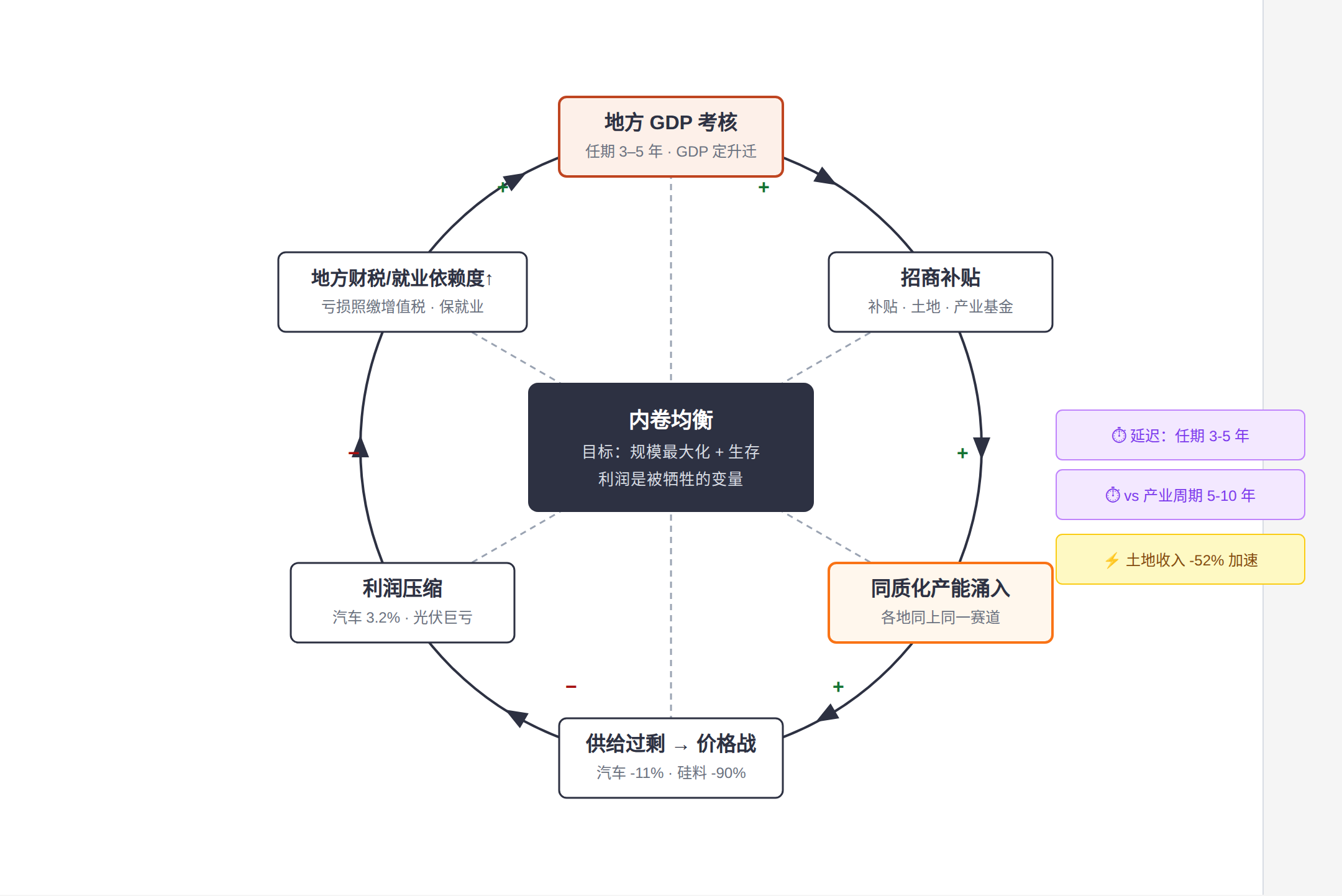
What does the structure look like? I drew a diagram: nine reinforcing loops, two balancing loops.
The Core Loop: The Local-Government GDP Tournament
The main loop in the diagram has only six stops. One trip around it tells the story.
Officials are assessed on GDP, over three-to-five-year terms. As soon as the pressure is on, the subsidies, cheap land, and industry funds follow. Every locality jumps into the same sector at once, identical capacity floods in, supply outruns demand, the price war starts, and margins get crushed.
Margins crushed, the locality should in principle pull back. It doesn't. The more firms lose money, the more the locality depends on them — VAT still gets paid, jobs have to be protected, the GDP number is still there. The deeper the dependence, the stronger the pressure for the next round of investment promotion, and the loop turns again.
Fiscal rules are the fuel in this loop. VAT is split 50-50 between central and local government, and the local share goes to where the tax is paid. In 2024, the local VAT share came to roughly 30% of local governments' own-source revenue.
The VAT base is value added — wages, depreciation, interest, and profit all count — so losses don't stop the tax. GDP is counted where production happens, so the wages and depreciation of a loss-making factory still add to value added.
Bring in one factory and the locality collects four things at once: GDP, VAT revenue, jobs, and land-sale income. Not one of them is tied to the firm's profit.
Land-sale revenue has fallen 52% from its 2021 peak. The land-selling route is narrowing, but the investment tournament hasn't stopped — it has shifted from "selling land" to "grabbing industries." Land-sale revenue still made up 34% of local own-source revenue in 2025.
Six More Loops Turn the Lock Tighter
Beyond the main loop, six more reinforcing loops are turning at the same time.
Lending follows size, not profit. Banks favor heavy-asset collateral, and localities add implicit guarantees, so the bigger you are, the easier the money comes — and the money goes into more expansion, which makes you bigger still.
Losses are not an exit signal; they are the reason for the next round of financing. Chinese automakers raised about $15.6 billion in equity financing in 2025, while industry EBITDA fell 10% year on year.
Herding is rational. One success story in a sector, amplified by media and policy signals, and everyone piles in. As the success rate falls, anxiety rises instead: the next wave is the one to catch early.
Technology spreads fast, supply chains are mature, entry barriers are low, and this loop spins at high speed. Hefei bet on Changxin Memory and lost ¥36 billion over ten years before a single quarter's net profit topped ¥33 billion. What other localities copied was usually just the "bet on the hot sector" part.
Costs can only be pushed onto people. Once the price war starts and margins are squeezed, the pressure goes upstream into longer supplier payment terms and inward into longer hours. Whoever keeps to the 44-hour week first loses the price war first.
996 is the equilibrium this loop computes. Platform algorithms add fuel: ranked by lowest price, sellers have to cut prices to buy traffic. Social security contributions are levied on wages and don't move with profits, so this loop only slows when costs hit the statutory floor.
The controlling shareholder's money is decoupled from the firm's profit. In state firms, the controlling shareholder is the local government, incentivized toward scale and jobs; in private firms, it is the founder, incentivized toward market value and related-party deals.
Different routes, same destination: the objective function is scale, not profit. The cost of losses never lands on the decision-maker, so the negative feedback that should correct course is cut off.
Dividend taxes push profits to stay inside the firm. An individual shareholder pays tax on dividends: 20% on dividends from unlisted companies; for listed shares it depends on holding period — 20% if held under a month, 10% for one month to a year, exempt beyond a year. Retained profits reinvested pay no tax, and capital gains on selling A-shares are exempt for individuals for now. Paying out is the worst option; keeping the money inside is the cheapest — so the money goes into expansion.
The more is retained, the more gets reinvested, the more capacity is added, the bigger the firm gets, the more profit there is to distribute — but distributing means paying tax, so it stays inside and gets reinvested again. The faster this loop turns, the more excess capacity piles up. For long-term holders of listed shares, dividends are exempt and the loop is weak; for individual shareholders of unlisted firms, the 20% is real, and the loop turns hardest.
There is one more explanation I cannot verify. Some say firms fear that high profits attract regulators, so they trade price for volume on purpose. But the harder the price war gets, the lower industry profits fall, so the idea that "high profit means danger" should fade, not strengthen. The chain doesn't connect.
At most, it worked briefly during periods of intense enforcement, in isolated cases. I include it here because it gets cited often as an explanation — and the evidence doesn't support it.
Why the Two Brakes Don't Work
The system has two balancing loops built in. One is weak, the other has failed.
The anti-involution policy is the weak one. It was raised in July 2024, escalated to "deepen the rectification" in December 2025, and PPI turned positive in March 2026, ending 41 months of decline.
It has had some effect, but unevenly: steel and solar responded, autos barely did — auto manufacturing profits still fell 19.5% year on year in the first half of this year. From Beijing's decision to local implementation takes 12 to 20 months.
It is fighting nine reinforcing loops that push from the bottom up. Until the incentives in assessment and lending change at the source, policy can only treat the symptoms at the level of prices.
Market exit is the failed one. Overcapacity, price war, chronic losses, bankruptcy and exit, capacity falls, prices recover — the chain works in the textbook.
In reality, subsidized life support, local protection, bank forbearance, and the need to protect jobs block it link by link. Exit moves far more slowly than capacity floods in.
Consumption and Exports: Both Exit and Entrance
Many people put consumption and exports at the end, as "impacts." I think that's the wrong place for them. They sit inside the system — outputs of involution, and inputs to the next round of it.
Consumption first. The price war squeezes profits, profits squeeze wages, lengthen hours, and stretch supplier payment terms, household income growth slows, consumption lags, domestic demand falls short, excess capacity gets even harder to absorb, and the price war gets fiercer.
Cheaper prices help consumers in the short run, but the income effect dominates, and the net result is negative. Household consumption is only about 38% of GDP, against a global average of 55% to 60%. The domestic market's capacity to absorb expanding supply is structurally limited.
Then exports. Excess capacity leaks abroad: 6.346 million cars exported in a year, more than 60% of solar module capacity aimed overseas. Exports protected growth and jobs — and protected the capacity that should have exited. The pressure to clear out leaked away, and capacity kept expanding.
When external demand turns, the relief valve becomes a return pipe. Cheap exports push down prices abroad — Goldman Sachs estimates each additional percentage point of exports lowers other countries' prices by 0.5% — trade friction, anti-dumping cases, and tariffs follow, exports stall, the surplus flows back home, and the price war gets worse.
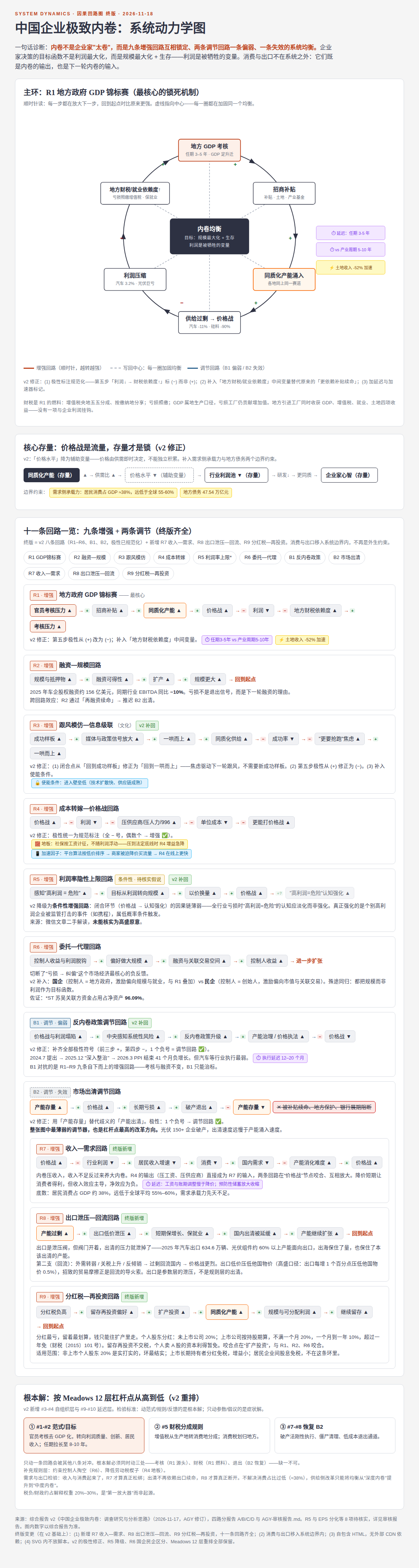
The Fundamental Fix Has to Move Three Things at Once
Move one loop and the others offset it. My judgment is that the fundamental fix has to move three things at once, and none can be left out.
First, strip GDP out of officials' performance assessment and replace it with profit quality, innovation, and household income, with terms lengthened to match the industrial cycle. That is the source of the main loop.
Second, change the fiscal sharing rules. Move VAT sharing from the place of production to the place of consumption, assign consumption tax revenue to local governments, and fill the gap with transfer payments. That is the fuel of the main loop.
Third, restore exit. Enforce bankruptcy law strictly, clear out zombie firms, write off banks' bad debts, and open low-cost exit channels. This is the weakest balancing loop in the whole diagram — and the highest-leverage direction for reform.
Two more: constrain controlling shareholders from tunneling value out through related-party deals, so the cost of losses lands back on the decision-makers; and cut the labor tax wedge. By the World Bank's measure, the total tax and contribution rate on Chinese firms is 59.2%, of which labor taxes account for 46.2 percentage points.
For a manufacturer running at a 5% margin, taxes and fees can reach 2.3 times its profit. A 10% price cut means losses, while taxes and fees fall only 23% and social security contributions don't fall at all. A price war tests cash endurance, not profit margins.
The tax burden accounts, in my view, for roughly 20% to 30% of the explanation. It amplifies the problem; it is not where the problem starts. Without it, involution would still exist, but as a shallow, short cycle; with it, involution becomes a deep, long structural equilibrium.
One more half-sentence is needed: fix all three, and if consumption doesn't recover, the equilibrium margin only climbs from extremely low to low. Once household income and consumption rise, the consumption loop genuinely loosens; once exit no longer depends on export life support, the export loop genuinely breaks.
Who Didn't Get Killed, and Why
Sungrow and Pop Mart are two counterexamples, but look at them closely.
Sungrow's inverter gross margin is 35%, overseas revenue is over 60%, overseas gross margin is 40.36% against 18.75% at home, it walked away from negative-margin projects on purpose, and energy storage became a second growth curve.
But its net profit fell 54% in the fourth quarter of 2025 and 40.12% in the first quarter of this year. What it won was a window of time.
Pop Mart's gross margin is 72.1%. Labubu alone brought in ¥14.16 billion, and overseas prices run nearly double domestic ones. But a single IP accounts for 38% of revenue, and when the growth guidance was cut, the stock fell more than 30% in two days.
What they share isn't at the parameter level. They stopped competing on the same dimension and opened a new track — IP scarcity, technology barriers, premium pricing abroad, the willingness to turn down low-price orders. Those are breaks at the structural level, and they worked by switching tracks.
This analysis has its limits, too. It describes industries that are homogeneous, scalable, and easy to enter. Where barriers are high and technology spreads slowly, the herding loop can't get going.
During periods of intense enforcement, the unverified profit-cap explanation may hold briefly. Beyond those bounds, discount the conclusions accordingly.
Ending
Involution is not a moral problem. It is a structural one. Blaming entrepreneurs for competing hard is like blaming the thermometer.
Assessment, fiscal sharing, and exit have to move together, with demand following, before the system has a chance to settle into a different equilibrium. Move prices alone, shout slogans alone, and the loops keep turning — the next round only gets worse.
Which loop is your industry stuck in? Leave a comment.